European Approval On Exhausts

You've probably heard it before: questions and sometimes even horror stories about exhausts and the mandatory E-Approval certification. Things like: 'E-Approval is becoming mandatory,' 'In Germany, they took my motorcycle away,' or 'Soon, nothing will be allowed anymore; I'm selling my bike!' Many different stories circulate, and even for us, it’s sometimes unclear what is and isn’t allowed. So, what do you do when you're unsure? You start researching and compile an overview of everything experts have written on the subject to provide yourself—and more importantly, your customers—with a clear and concise explanation. At least, that’s our hope! Below, we’ve listed various articles from different forums, focusing on the expertise and experience of the writers or the companies they represent.
WWW.ANWB.NL
The E-Approval along with the test number indicates that the exhaust has been tested and approved for a specific motorcycle. However, the basic rule is that you should not exceed the permitted noise level. If your noise production exceeds what is listed in the vehicle’s specifications, it is always prohibited. An E-Approval is therefore not a free pass and, in theory, even an original exhaust that is old and worn out could produce too much noise. You risk a fine and may even be prohibited from continuing your planned route. In Germany, if the E-Approval is missing, you must have the exhaust system inspected and registered by a certification body (note: this applies if you reside in Germany). It must be an approved system. A non-approved exhaust system is not allowed.
WWW.MOTORSTOF.NL
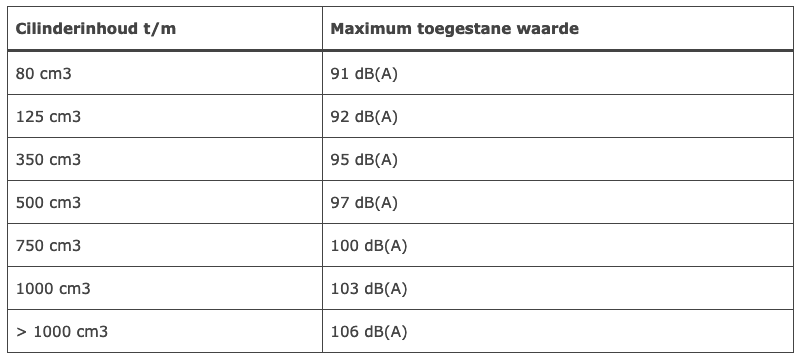
For older motorcycles, it may occur that the maximum number of decibels (dB) is not known by the RDW. Unfortunately, this doesn’t mean you can make unlimited noise. The RDW has outlined the following guidelines for maximum values based on your motorcycle’s engine displacement. If you think a ‘quiet’ exhaust is enough, think again. You can be fined not only for exceeding the maximum dB(A) but also for unnecessary noise. Article 57 of the 1990 Traffic Regulations states: 'Drivers of motor vehicles, mopeds, and scooters may not cause unnecessary noise with their vehicle.' This means intentionally revving your engine—whether in neutral or with the clutch in—can result in a hefty fine. As of this writing, such a fine costs €390, excluding administrative fees.
WWW.UITLAATSTORE.NL
There are several legal requirements for your exhaust. An exhaust must not produce excessive noise, and a replacement exhaust must have type approval. For this, a European certification mark for exhausts has been introduced. A replacement exhaust must have a brand, a type designation, and an E-Approval with a set of numbers (indicating in which country the approval was issued). An original or replacement exhaust must never exceed the legally permitted maximum noise level. This is often stated on your registration certificate. In the Netherlands, noise checks are rare but can result in a fine if you’re pulled over. However, some countries regularly check for noise levels. Switzerland, for example, is said to be particularly strict. In Germany, noisy riders are also targeted, but you usually need to draw attention to yourself first. In France, they are reportedly more tolerant of 'sporty' exhausts. If you normally ride in the Netherlands with a loud aftermarket exhaust without E-Approval approval and want to play it safe, consider using your original exhaust or one with an E-Approval while abroad. Otherwise, avoid Switzerland and keep your revs low in Germany by shifting gears earlier. An approved exhaust without a dB-killer technically no longer meets the requirements. Police enforcement can vary: you may get off with a warning or be asked to reinstall the dB-killer on the spot. In the worst-case scenario, your license plate could be temporarily invalidated, requiring RDW inspection to make it valid again.
WWW.RIJDMOTOR.NL
When purchasing an aftermarket exhaust, there are some key considerations. For example, if you plan to ride in Germany, a country with stricter noise regulations for motorcycles, make sure your exhaust is approved. An approved exhaust will have an E-Approval and an installed dB-killer. If your exhaust produces too much noise or lacks an E-Approval, it is officially not allowed on public roads. Some countries enforce these rules more strictly than others. Even in the Netherlands, noise checks are becoming more common. With an eye on the future, having an approved exhaust isn’t a bad idea!
WWW.MOTORACTIEGROEP.NL
In the KNMV’s member magazine "Grip," we read in late 2020 that the organization is advocating for mandatory RDW inspections when installing a non-standard exhaust on motorcycles. If the noise level is within the limit, you’ll receive a certificate. Are you pulled over by an officer? With a standard exhaust, there’s no problem. With a different exhaust, you’ll need to show the RDW certificate proving it meets the noise limits. This eliminates the need for noise tests during roadside checks, allowing better enforcement of the noise standards. Of course, we asked KNMV what they mean by a non-standard exhaust. We didn’t get a clear answer. Our take? There are two possibilities: 1) It applies to any exhaust not originally supplied with a new motorcycle, even approved replacement exhausts with E-Approval certification. Or 2) It applies only to exhausts without E-Approval certification, meaning those not approved for public road use. There’s no third option. In the first case, the rule would require you to undergo an expensive inspection to confirm your already-approved exhaust meets the noise standards—a needless expense. In the second case, the rule already exists: if you want to use a non-approved exhaust on public roads, you must have it inspected. The chances of being pulled over are minimal, and the fine costs less than the inspection. The E-Approval simply indicates that a certain exhaust is approved for one or more motorcycles. Install that exhaust on another motorcycle, and it’s no longer compliant. Remove the dB-killer or modify it? Same story. This applies to motorcycles with or without an RDW certificate. New measures like these are never retroactive, meaning it could take 10 to 20 years for any noticeable reduction in noise pollution. Without government intervention and collective effort from motorcyclists, most popular riding roads will likely already be closed by then.
WWW.DOMINATOR-EXHAUSTS.NL
We at WC-eend recommend WC-eend! That’s not how we want to come across, but we do want to share our experiences over the past five years from customers and trade shows. What stands out most is that the KLPD (the Dutch police, who are also among our customers) themselves indicate that a tolerance policy applies in the Netherlands. As long as you ride in the Netherlands with a sports exhaust without E-Approvalk approval but WITH a dB-killer, there’s usually no issue. The key is that your exhaust doesn’t produce excessive noise. Even with an E-approved exhaust, you can still be fined if you exceed the noise limit, just as you can with an original or aftermarket exhaust. The key is to ensure the exhaust is sufficiently muffled, either with the standard dB-killer or one that provides extra damping. Every motorcycle has a maximum dB level, usually indicated on the motorcycle's data plate. If no dB level is listed, the RDW provides the following table:
At RDW inspections for motorcycles with non-original exhausts without approval (of course, Dominator exhausts), we’ve never encountered issues. The only recommendation we receive is: 'Just keep the dB-killers installed, and you’ll almost always be fine.' What does the future hold? That remains unclear. After EURO4 and EURO5, we’re waiting for exhausts to become virtually silent. The term 'Loud pipes save lives' no longer applies, but until then, we’ll do our best to serve enthusiasts!